
FACIAL PROFILOMETRY AND DIGITAL SIMULATION · MÁLAGA
Understanding your face
before deciding on surgery
Facial profilometry and digital simulation allow me to study your proportions, understand the anatomy that shapes your face and explore possible changes with you before surgery. Their purpose is not to predict an exact outcome, but to establish a shared goal and a plan that respects your individual features.
facial analysis
Anatomy comes before appearance

Facial profilometry is the study of the proportions and anatomical relationships that contribute to facial balance. Before considering any changes, I examine the underlying bone structure, soft tissues and the relationships between different facial features to understand what might be changed and what should be preserved.
When assessing the nose, this includes factors such as the length of the nasal bones, skin thickness, the arrangement of the cartilages and their relationship with the rest of the facial profile. If a functional problem is suspected, the assessment also includes the internal nasal structures.
The aim is not to make every face conform to an ideal set of proportions, but to understand your individual anatomy and use that knowledge as the foundation for coherent surgical planning.
a considered approach to planning
digital simulation
Exploring possibilities before making decisions
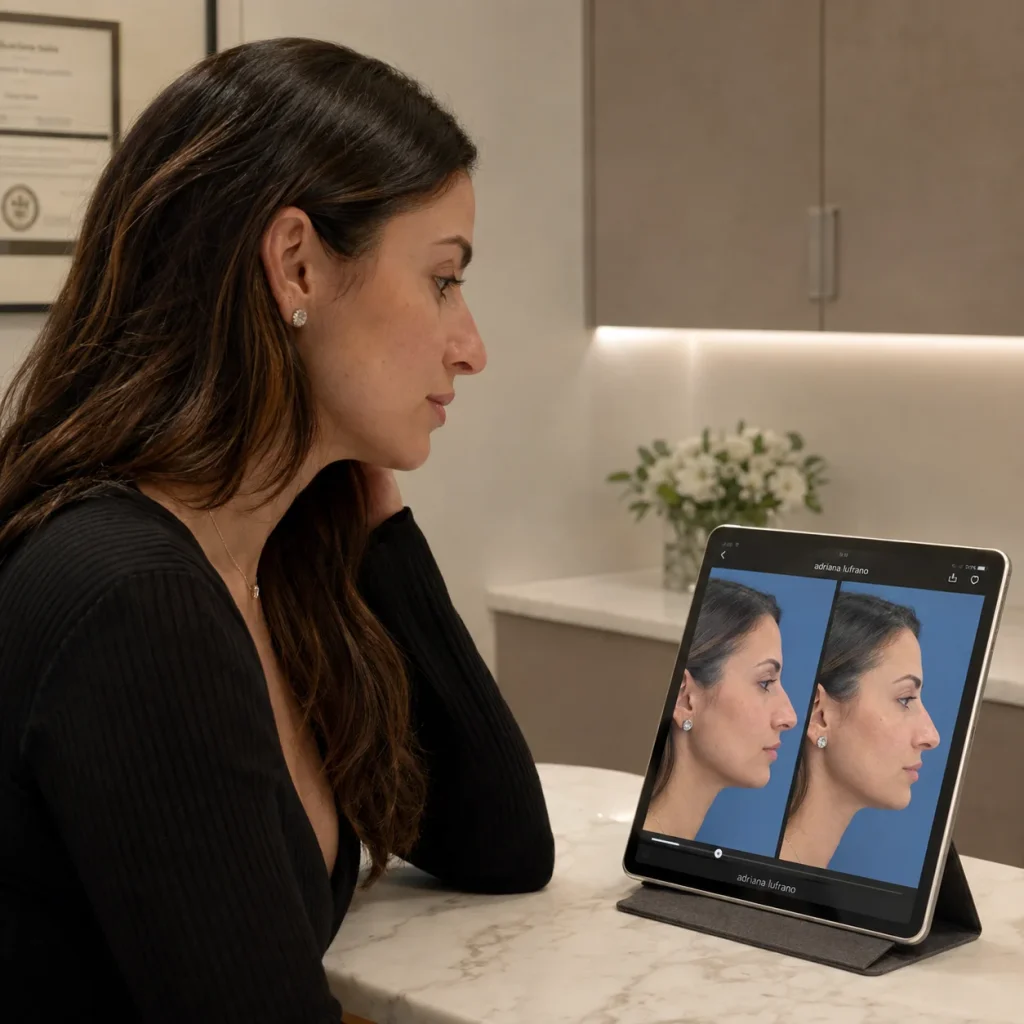
Digital simulation makes it possible to explore how certain changes might affect facial balance before surgery. Using photographic analysis and information gathered during your assessment, I work with images of your face to consider different possibilities in shape, projection and proportion.
It is not intended to reproduce the exact outcome of surgery. Tissues change over time, anatomy imposes limits and everyone heals differently. Its value lies elsewhere: it turns an abstract idea into a visual reference we can discuss together.
In this way, simulation helps us identify which changes may suit your face, which may not, and how closely our expectations align before agreeing on a surgical plan.
SURGICAL PLANNING
From analysis to a shared plan
Profilometry and simulation do not replace surgical judgement, but they help inform and structure it. Anatomical findings, functional examination and the expectations discussed during your consultation are brought together to establish which changes are reasonable, which structures should be preserved and which priorities matter most.
In rhinoplasty, this may help guide decisions about the bridge, tip, projection, support and the relationship between the nose and the rest of the facial profile. Where there are functional concerns, these are considered within the same assessment.
The result is a plan developed before surgery: not an image to be replicated exactly, but a shared point of reference between patient and surgeon, allowing decisions to be made with greater clarity.
01
ANATOMY
Understanding the structure and its proportions.
02
SIMULATION
Exploring possibilities before surgery.
03
DECISION
Agreeing on a shared, achievable goal.
science and an artistic eye
Precision also calls for sensitivity
Facial planning involves measuring, analysing and understanding anatomy, but also recognising what makes each face unique. My experience of oil painting has shaped the way I observe: proportions, volumes, light, transitions and subtle details that cannot be reduced to a number.
That visual sensitivity is part of my approach to facial surgery. For me, simulation is therefore not an exercise in transformation, but a way to bring analysis and perception, precision and aesthetic judgement together, always respecting the patient’s identity.

WHAT IT BRINGS TO THE PROCESS
Greater clarity before surgery.
Profilometry and simulation do not replace clinical discussion or surgical judgement. Their value lies in making the planning process easier to understand and helping patient and surgeon reach decisions together.
/01
To understand your expectations
Turning what you would like to change into images helps clarify what concerns you, what outcome you hope for and which adjustments might be appropriate for your anatomy.
/02
To plan your procedure
Anatomical, functional and visual information helps identify which goals should take priority and which structures should be preserved during surgery.
/03
To support informed decisions
Understanding the possibilities and limitations of surgery helps you approach the process with more realistic expectations and a shared reference point with your surgeon.
APPLICATION IN RHINOPLASTY
When your profile forms part of the decision
In rhinoplasty, profilometry and simulation help assess how the nose relates to the rest of the face before a surgical plan is agreed. They allow us to consider details such as the length of the nasal bridge, tip projection and rotation, the nasolabial angle and the relationship between the nose, lips and chin, always within the context of each patient’s anatomy and nasal function.
Simulation can help us explore different possibilities and discuss expectations, but it is not a promise of the final result. Surgery must ultimately be adapted to the patient’s actual anatomy, tissues and individual healing response.
essential information
Frequently asked questions about facial profilometry and digital simulation
what is the difference between facial profilometry and digital simulation?
Facial profilometry analyses the proportions and anatomical relationships of the face. Digital simulation uses this information, together with photographs and clinical assessment, to explore possible changes visually before surgery. One helps us understand the anatomy; the other helps us visualise possibilities.
will the simulation show exactly what I will look like after surgery?
No. A simulation cannot predict the exact outcome of surgery. Changes in the tissues, healing and each patient’s anatomical characteristics influence the final result. Its purpose is to support discussion, help us share expectations and agree on a common goal before surgery.
are profilometry and simulation used only for rhinoplasty?
Not necessarily. They are particularly useful when a procedure may alter the proportions of the face or the relationships between different facial structures. Whether they are used depends on the procedure and on whether the analysis provides information that is relevant to planning.
when is the profilometry and simulation assessment carried out?
It takes place during the preoperative assessment process, once the patient’s anatomy, expectations and functional needs have been reviewed. It forms part of advance planning and helps establish which changes may be appropriate before the surgical plan is finalised.
PERSONALISED ASSESSMENT
Understand before you decide
Each profilometry and simulation assessment begins with an individual evaluation of your anatomy, facial proportions and expectations. The aim is to establish a shared point of reference so that decisions can be made with greater clarity before surgery.
Last medical review: October 2026
Contact us
and begin your assessment
We would like to understand your needs so that we can offer personalised advice and support, from your first consultation through to recovery. Complete our form and we will get in touch.