
FACE AND NECK LIFT · MÁLAGA
Face and neck lift to reposition tissues without changing your expression
Over time, it is not only the skin that changes. Deeper tissues also descend, the jawline loses definition and the relationship between the face and neck changes. This is why it is important to assess both areas together.
A face and neck lift can address these changes using techniques such as deep plane, which releases and repositions deeper tissues to achieve a natural, balanced result.
CHANGES IN THE FACE AND NECK
The face and neck change as one connected unit
Over time, it is not only the skin that changes. Deeper tissues can also descend, the jawline may lose definition and the relationship between the face and neck can change. This is why assessing both areas together is important for achieving a natural, balanced result.
A face and neck lift can address these changes using different surgical techniques. One of these is the deep planetechnique, which allows deeper tissues to be released and repositioned. Depending on each patient’s needs, additional procedures may be incorporated to address other aspects of facial ageing.
/01
LOSS OF JAWLINE DEFINITION
As the tissues descend, the jawline may become less defined, contributing to laxity in the lower face.
/02
DESCENT OF THE MID AND LOWER FACE
Loss of support can gradually alter the relationship between the cheek, nasolabial fold and jawline.
/03
PLATYSMAL BANDS
Over time, the edges of the platysma muscle can become more visible, forming vertical bands at the front of the neck.
/04
NECK LAXITY
The skin and tissues of the neck may lose firmness, changing the definition of the angle between the jaw and neck.
SUITABILITY
It is not a question of age, but of anatomy
/01
WHAT WE ASSESS
The position, laxity and quality of the tissues, jawline definition, the relationship between face and neck, the presence of platysmal bands and the distribution of facial volume.
/02
WHAT WE DECIDE
Whether surgery is appropriate, which areas need treatment, how extensive the procedure should be and how to combine support, tissue adaptation and tissue quality.

SPECIAL CONSIDERATIONS
Has your face changed after losing weight?
Significant weight loss can make facial volume loss, skin laxity and changes in facial contours more noticeable. In these cases, a personalised assessment should consider both the position of the facial tissues and the distribution of volume, as not all changes can be addressed with a facelift alone.
EXTENT OF TREATMENT
Face and neck lift or mini facelift: the difference lies in what needs treating
The term mini facelift is generally used for more limited procedures, but it does not describe a single surgical technique. The difference is not simply the type of incision or the tissue plane involved. It depends on which areas need treatment and how far surgery needs to extend.
MINI FACELIFT
Suitable for selected patients whose concerns are more localised and do not require extensive treatment of the face and neck.
It may focus on particular areas of the lower face and jawline and, in some cases, address limited changes in the neck.
FACE AND NECK LIFT
When changes affect the face, jawline and neck together, more extensive treatment may be needed to release and reposition the tissues while maintaining continuity between these areas.
The extent of surgery is determined by each patient’s anatomy and individual needs, rather than by the name of the procedure.
SURGICAL TECHNIQUE
Deep Plane and Extended Deep Plane: releasing and repositioning deeper tissues
The deep plane technique forms the surgical foundation of my approach to face and neck lifting. It involves working beneath the superficial musculoaponeurotic system (SMAS), releasing structures that restrict tissue movement to allow repositioning in harmony with the patient’s anatomy.
The aim is not simply to tighten the skin, but to address the deeper structures that support and determine the position of the face, particularly the mid and lower face and their relationship with the jawline and neck.
In selected cases, tissue release and repositioning can be carried out more extensively using a technique known as Extended Deep Plane. This is not an additional procedure or a different operation, but a more extensive variation of the deep plane approach, chosen according to each patient’s anatomy and individual needs.
/01
DEEP PLANE
Repositioning the deeper support structures
Releasing structures that restrict tissue movement when this is necessary to reposition them.
/02
SMAS AND PLATYSMA
Treating the connection between jawline and neck
Working with the facial support system and its continuity into the neck according to each patient’s anatomy.
/03
SKIN
Adapting the skin without placing all the tension on it
Draping the skin over the repositioned tissues without concentrating all the corrective tension in the skin.
REJUVENATION STRATEGY
Integrated Rejuvenation
Reposition · Reshape · Stimulate
A face and neck lift, using the deep plane technique, forms the surgical foundation of the treatment. However, facial rejuvenation depends not only on tissue position, but also on tissue quality and how the tissues respond and evolve over time.
For this reason, the same operation may combine the repositioning of deeper tissues with complementary procedures aimed at adapting the tissues, improving their firmness and stimulating processes associated with tissue remodelling and collagen production.
The aim is to address three distinct aspects of treatment together, according to each patient’s individual needs: repositioning, reshaping and stimulating.
/01
Reposition
Restore support and position
The deep plane technique allows descended deeper tissues to be released and repositioned, with the extent of surgery tailored to each patient’s anatomy.
/02
Reshape
Adapt and redefine the tissues
Removing excess tissue and treating tissues where indicated helps adapt the contours and address firmness during the same operation.
/03
Stimulate
Support tissue quality
During the same operation, additional treatments may be used to stimulate processes involved in collagen production, remodelling and tissue quality.
INCISIONS AND SCARRING
Scars cannot be eliminated: they can be planned
In a face and neck lift, the design of the incisions is part of the plan from the outset. Their course is adapted to each patient’s anatomy, the extent of treatment and the structures requiring attention.
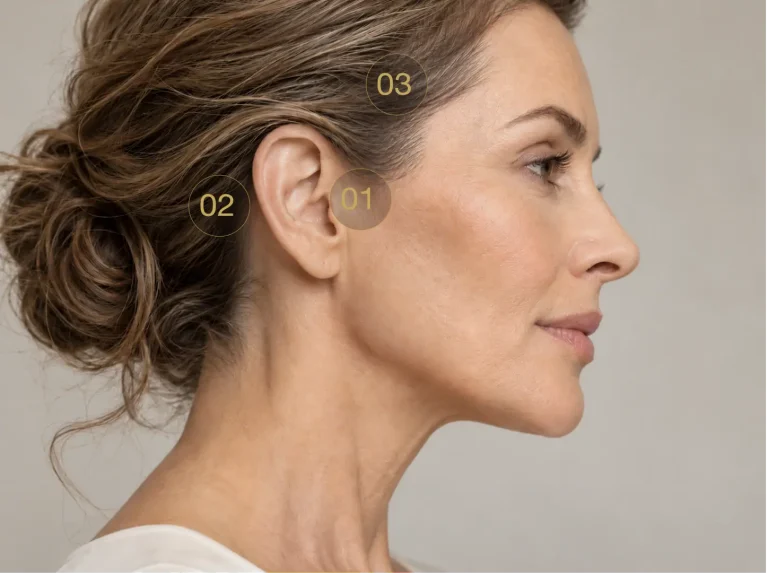
Incisions usually follow the natural folds around the ear and, depending on the case, may extend behind it and towards the hairline. The aim is to provide the necessary access to the different tissue planes while placing scars in as discreet a position as possible.
How scars mature depends on several factors, including the incision site, closure technique, tissue quality, postoperative care and each patient’s individual healing response.
/01
In front of the ear
The incision can follow the natural folds in front of the ear to blend with its contour.
/02
Behind the ear
When neck structures need treatment, the incision may continue along the crease behind the ear.
/03
Hairline
In some cases, the incision may extend into areas near or concealed by the hair, depending on the extent of surgery.
RECOVERY
Recovery is supported, not rushed
After surgery, swelling, a feeling of tightness and certain temporary changes in sensation are part of the early recovery period. Their severity and duration depend on the extent of surgery and each patient’s response.
Over the following weeks, the appearance of the face and neck continues to change as swelling subsides and the tissues gradually settle.
Follow-up appointments allow healing to be assessed, progress to be monitored and advice to be tailored to each stage as patients gradually return to their usual activities.
Additional outpatient treatments, where indicated, are planned later and according to the progress of tissue healing. They are not part of the initial recovery stages after a facelift.
01
FIRST FEW DAYS
Managing swelling, relative rest and monitoring the incisions. Tightness, swelling and temporary changes in sensation are common.
02
FIRST FEW WEEKS
Swelling gradually subsides and the jawline and neck contours begin to become more defined, although the tissues are still settling.
03
MEDIUM-TERM RECOVERY
Scars and deeper tissues continue to change over the following months. The outcome should be assessed gradually, not during the earliest stages of recovery.
SURGICAL JUDGEMENT
Rejuvenation does not mean transformation
Planning a face and neck lift does not begin with a standardised idea of youth, but with each patient’s anatomy, proportions and existing expression.
Where surgery is indicated, repositioning tissues can improve facial and neck definition. The aim, however, is not to erase every sign of ageing or change the features that make a face recognisable.
The extent of treatment, direction of repositioning and structures involved are decided individually to maintain a harmonious relationship between support, contour and facial identity.
The same individual approach applies to any additional treatment: more procedures do not necessarily mean a better result. They are included only when there is a specific objective and clinical indication.
ESSENTIAL INFORMATION
Frequently Asked Questions About Face and Neck Lifts
what is the difference between Integrated Rejuvenation and the deep plane technique?
The deep plane technique allows deeper facial tissues to be released and repositioned and forms the surgical foundation of a face and neck lift.
Integrated Rejuvenation is a broader approach to treatment planning that considers three aims: repositioning, reshaping and stimulating. It may incorporate additional procedures during the same operation, depending on each patient’s needs.
how long do the results of a face and neck lift last?
Results may last for years, although surgery does not stop the natural changes that continue over time.
How the result develops depends on factors such as tissue quality, the extent and technique of surgery, lifestyle habits and each patient’s individual characteristics. Later changes tend to appear gradually.
what type of anaesthesia is used for a face and neck lift?
The type of anaesthesia depends on the extent of the procedure and the surgical plan. A full face and neck lift may require general anaesthesia, while other approaches may call for a different anaesthetic plan.
The most appropriate option is determined individually with the anaesthetic team.
is an overnight hospital stay necessary after surgery?
This depends on the extent of surgery and how recovery progresses during the first few hours. In some cases, observation until the following day may be recommended before returning home.
The decision is tailored to the procedure performed and each patient’s circumstances.
are additional treatments necessary after a face and neck lift?
No. Subsequent outpatient treatments are not essential to achieving a good result from a facelift.
They may be recommended for selected patients to address specific aspects of tissue quality and healing. Their suitability is assessed individually during follow-up.
These treatments are separate from any additional procedures that may be planned and performed during the operation itself.
can a face and neck lift be combined with other procedures?
Yes. Depending on each patient’s needs, a face and neck lift may be combined with other procedures, such as a temporal lift, blepharoplasty or facial fat grafting.
The choice depends on anatomy, treatment goals and whether the combination can be performed safely.
what are the risks or possible complications of a face and neck lift?
As with any surgery, a face and neck lift may involve risks such as haematoma or bleeding, infection, healing problems, temporary or persistent changes in sensation, asymmetry or complications involving nerve structures.
There are also risks associated with anaesthesia and other, less common, complications depending on the technique and the patient’s circumstances. Preoperative assessment and informed consent provide an opportunity to discuss these individually before surgery.
PERSONALISED ASSESSMENT
Understanding what has changed is the first step towards deciding how to treat it
The consultation allows us to assess the relationship between the face, jawline and neck, identify the changes to be addressed and determine how to apply the Integrated Rejuvenation approach in each case, considering three objectives: repositioning, reshaping and stimulating.
It also allows us to assess tissue quality and determine whether additional procedures should be incorporated during surgery. Not every patient requires the same combination of procedures or the same extent of treatment.Get in touch
and begin your assessment
Tell us what changes you’ve noticed in your face or neck and what you would like to improve. During your consultation, we’ll assess your anatomy and expectations to determine which options may be suitable for you.
MEDICAL JUDGEMENT AND EVIDENCE
Clinical Information and Sources
The information on this page has been prepared on the basis of clinical practice in facial plastic surgery and draws, where relevant, on scientific literature concerning facial anatomy, deep plane and extended deep plane facelift techniques, the SMAS and platysma, scarring and postoperative recovery.
The suitability of additional treatments is assessed specifically according to the technique used, the available evidence and each patient’s circumstances.
DOI: 10.1097/00006534-199007000-00008
Deep Plane Anatomy for the Facelift Surgeon: A Comprehensive Three-Dimensional Journey.
DOI: 10.1016/j.fsc.2022.01.015
DOI: 10.1016/j.cps.2018.06.007
DOI: 10.1016/j.fsc.2017.12.011
Deep Plane Facelifts: A Systematic Review and Meta-Analysis of Outcomes.
DOI: 10.1007/s00266-026-06138-x